COSCO sent 2 of its largest ships trapped in the Persian Gulf out of the Hormuz on 30 March after an earlier aborted attempt on 27 March, as tensions in the Middle East continues to escalate. The 2 ships are the first non-Iranian linked container ships to come out of the Hormuz since 3 March. Iranian ships have meanwhile halted transits through the Hormuz over the past week, with several incoming ships waiting at Chabahar Anchorage while outgoing ships are mostly idle at Bandar Abbas. The impasse continues to disrupt cargo flows, with the temporary closure of operations at Salalah pushing more cargo to Khor Fakkan where waiting times continue to rise to an average of 5 days.
The increased threat of Houthis attacks on Red Sea shipping has not deterred CMA CGM from adding a 2nd Asia-Med string to the Suez route, as it reroutes the Mediterranean Club Express (MEX) eastbound starting from this week with calls at Jeddah enroute, in addition to the Phoenician Express (BEX2) service that is already back on the Suez on both directions.

 Johnson Leung

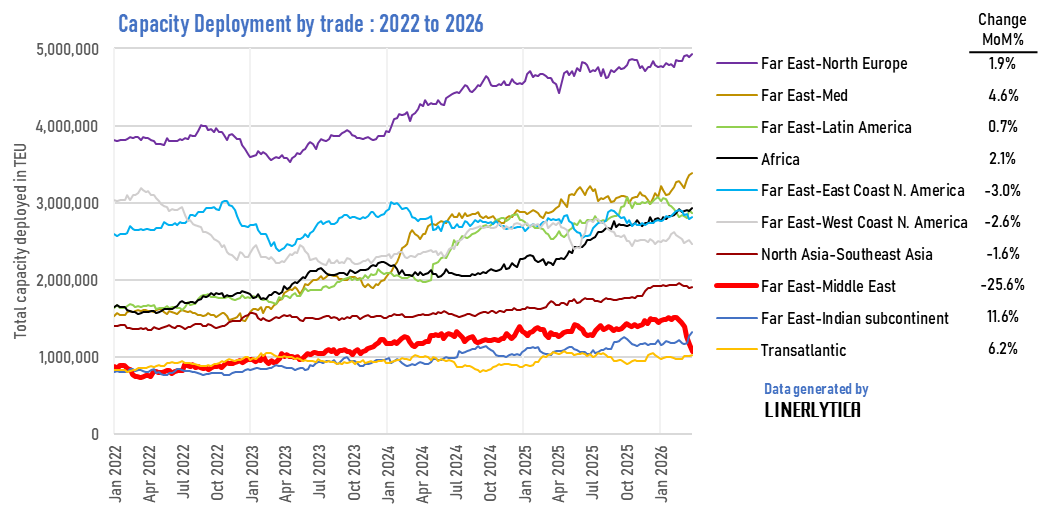
Far East-Middle East capacity drops sharply
Carriers have withdrawn a quarter of their Far East-Middle East capacity since the start of the Iran war, with further network adjustments still to come. The displaced capacity has not created any surplus supply thus far, as the ships have
been primarily re-assigned to the FE-India and FE-Med routes with additional India-Oman, Northern UAE and Red Sea connections needed to keep cargo flows to the Gulf states, that has also added to the heavy congestion that has built up at Salalah, Khor Fakkan and Mundra. However further capacity displacement would add pressure to other markets to absorb the surplus ships, with container cargo demand already reeling from the effects of higher oil prices.
Register Free Trial
Weekly/Monthly Market Pulse: US$1,500/US$1,800 per year